





The first legislative deadlines relating to food contact materials (MOCA) and the European Packaging and Packaging Waste Regulation (PPWR) are approaching, outlining an increasingly complex framework for the sector. In this context, Giflex organized the technical workshop “Challenges for safety and sustainability: between science and technology”, held on March 17 in Milan at the ADI Museum - Compasso d’Oro, with the aim of clarifying regulatory developments and their operational implications.
The main speakers were the coordinators of the association’s Scientific Committees, Andrea Cassinari, Rosi Barrale, and Laura Maurizio, who analyzed the main changes, highlighting their impact on compliance obligations for manufacturers and on the technical documentation required by customers and authorities. Indeed, 2026 is shaping up to be a crucial year for flexible packaging, marked by the overlap of key regulations and the end of related transitional periods, including Regulation 2024/3190 on BPA, Regulation 2025/351 on MOCA plastics, and Regulation 2025/40 related to PPWR.
As explained by Andrea Cassinari, Coordinator of the Giflex Scientific Committees:
Our Committees act as a proactive body within the association and are tasked with developing reference documents for the entire supply chain. The Committees work by activating highly specialized working groups, ensuring a strong focus on the topic of interest, close alignment with the food packaging sector, available market technologies, and increasingly safe and sustainable chemistry. The scientific rigor that distinguishes these activities prevents misinterpretations and greenwashing. The position papers and documentation we develop offer the market and stakeholders the possibility to evaluate practical solutions, enabling constructive dialogue and the exchange of data and methodologies between institutions and industry.
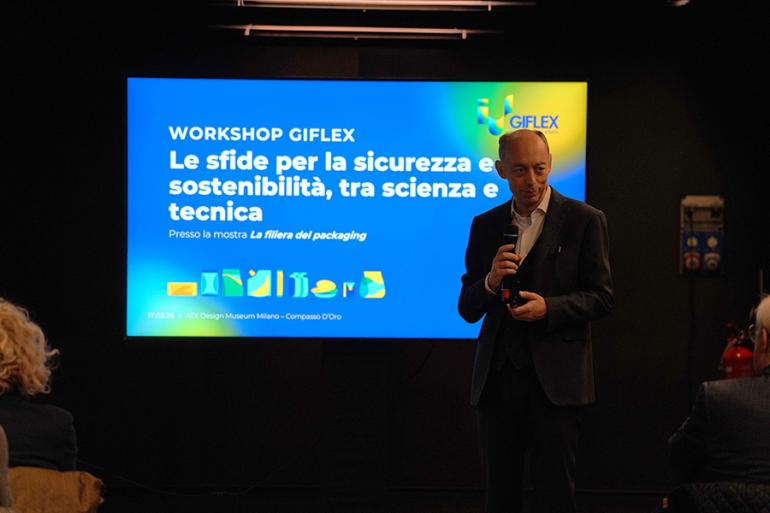
Rosi Barrale focused on the need to adapt operational models to new regulatory requirements, emphasizing how the legislative acceleration may create uncertainty, particularly when methodological gaps are difficult to fill at a company level. In this scenario, strengthening collaboration across the entire supply chain through association-led work becomes essential to managing regulatory complexity and recognizing safety not only as an obligation, but as a strategic, reputational, and market-access lever.
Laura Maurizio then analyzed the timeline of upcoming deadlines, noting that August 12, 2026 will mark the entry into force of the PPWR. Among the most significant points is the introduction of restrictions on the use of PFAS in food-contact packaging, as well as the launch of secondary legislation with the first implementing and delegated acts concerning calculation and verification methodologies for recyclability, recycling, and recycled content. Another key milestone will be 2035, when all packaging will have to be recyclable at scale according to criteria defined in the implementing acts. In this context, a supply‑chain-wide approach will be essential to ensure continued market access.
It was also highlighted that numerous aspects of the regulation still require operational clarification. For this reason, the publication of guidelines and Q&A documents by the European Commission is urgently awaited, as they will need to provide concrete instructions on how to apply the PPWR. Nevertheless, the principle remains that responsibility for compliance lies with the economic operator placing the packaging on the market, while the regulation significantly strengthens communication obligations along the supply chain, making collaboration between suppliers and manufacturers not only strategic, but necessary.
At the end of the event, Giflex President Alberto Palaveri reiterated the importance of a constructive and non‑ideological approach during this period of profound transformation for the sector.
“The Scientific Committees,” he emphasized, “provide scientific expertise and methodologies to support both members and legislators, contributing to a safe and sustainable transition toward the flexible packaging of the future.”
The workshop also featured contributions from Valter Rocchelli, analytical expert on the UNI/TS 11788 standard, and Agnese Chiscuzzu, partner at Bistoncini Partners.
Participants also had the opportunity to visit the exhibition “La filiera del Packaging,” organized by ADI – Associazione per il Disegno Industriale in collaboration with UCIMA, which illustrates the various phases of the supply chain, highlighting its structure, innovation, and the central role of the circular economy. As a supporter, Giflex joined the initiative together with the Paper and Graphics Federation, which includes Assografici, Assocarta, and Acimga.


