

Researchers from four Fraunhofer institutes launch the PAPURE project, paving the way for 100% recyclable packaging
Paper is already one of the leading players in the transition toward more sustainable packaging: high recycling rates, lower CO₂ emissions compared to plastic, and reduced disposal costs. Yet a technical limitation has so far held back its full green potential: to be sealed, paper requires adhesives or plastic layers. These components contaminate the material, complicate recycling processes, and reduce the quality of recovered fibers. The answer comes from Germany with the PAPURE project, which brings together four institutes of the Fraunhofer-Gesellschaft (Fraunhofer IAP, Fraunhofer IWS, Fraunhofer IVV, and Fraunhofer IWU). The ambition is clear: enable paper sealing without any additives, thanks to an innovative laser-based process.
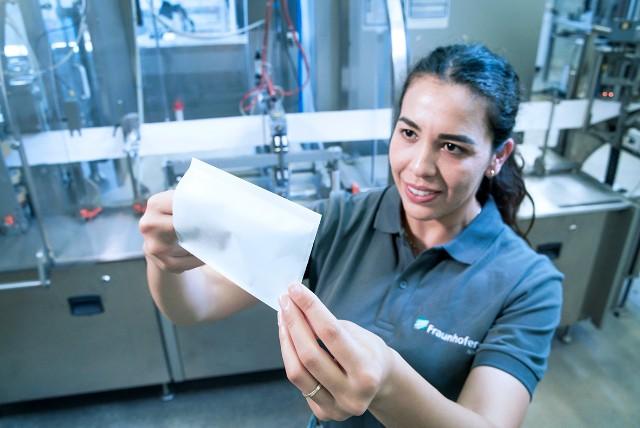
At Fraunhofer IWU in Dresden, a laboratory-scale production unit is currently being built to replicate the manufacturing process of a typical packaging material.
From fiber chemistry to heat sealing
The project begins with the raw material itself. Researchers at Fraunhofer IAP are analyzing around three dozen different paper types (coated and uncoated packaging papers, printing papers, and cardboard) to assess their suitability for binder-free sealing. Particular attention is being paid to cellulose, hemicellulose, and lignin content, which are crucial for adhesive properties and for the formation of the so-called cleavage products generated by the laser process. Analytical techniques such as scanning electron microscopy (SEM), high-performance anion-exchange chromatography (HPAE), and X-ray photoelectron spectroscopy (XPS) are used to map chemical composition and morphology before and after treatment.
One finding is clear: a high proportion of inorganic fillers such as talc and calcium carbonate negatively affects seam strength. Conversely, thicker papers, such as those used for disposable cups or food packaging, prove particularly suitable for the process.
The laser that “creates” the adhesive
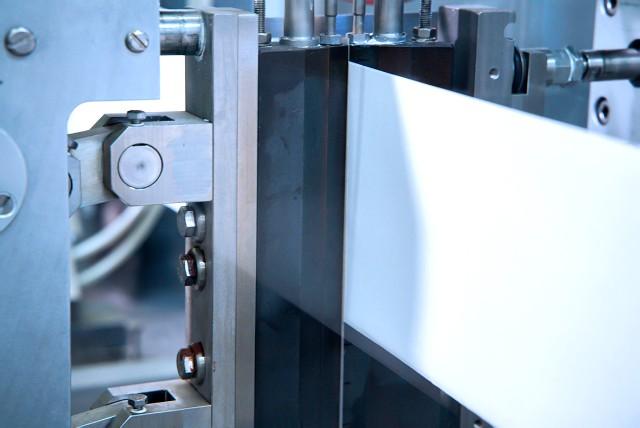
The technological core is developed by Fraunhofer IWS. The paper surface is irradiated with a carbon monoxide (CO) laser. Rapid heating transforms lignin, cellulose, and hemicellulose into short-chain compounds in a controlled process. The result? Refusible reaction products remain on the surface, resembling sugar-like substances that act as a natural adhesive. In practical terms, the adhesive is not added, it is generated directly from the paper itself. After laser treatment, two layers can be joined through conventional contact heat sealing, using heat and pressure to activate the cleavage products.
Bond strength and seam quality
Fraunhofer IVV is developing the dedicated sealing system, studying the interaction between material properties, laser parameters, and heat-sealing conditions. Mechanical tests, including shear and T-peel tests, are used to evaluate joint stability under different loads. Key parameters include sealing time, temperature, and pressure, as well as tool geometry. Fiber orientation relative to the sealing tool also plays a significant role in final seam quality.
The goal is to exceed the internal adhesion between the paper’s own layers. Results are already promising: a seal just 2 centimeters long and 3 millimeters wide can withstand 20 kilograms in shear tests.
From research to industrial roll-to-roll
Scalability is at the heart of Fraunhofer IWU’s work. A modular pilot-scale roll-to-roll line is under construction to produce flat, four-side-sealed bags typical of flexible packaging applications. The approximately six-meter-long system integrates both the laser module and the sealing module, along with industrial sensors (image and moisture sensors) and a digital twin supported by a trained data model. The process involves continuous irradiation of the first paper web, lamination with a second web, formation of four seams using a combined sealing and punching tool, and final cutting into bags.
A real-time seam quality monitoring system will enable dynamic adjustment of process parameters. The declared target: reaching a production rate of 10 packages per minute on the pilot line by September 2026.
interpack 2026: the debut
The demonstrator will be showcased at Interpack, taking place from May 7 to 13 in Düsseldorf, at the Technology Lounge of the VDMA (Hall 4, Booth C54). One of PAPURE’s greatest strengths lies in its integrability: both the laser module and the sealing system can be implemented independently in existing production lines. This makes the technology particularly attractive for machine manufacturers, packaging material producers and converters.
If industrial scalability confirms current results, paper could finally close the sustainability loop: no plastic, no adhesives, full recyclability. A concrete step toward packaging that doesn’t just claim to be green, but truly is.


