





Concrete targets on recycling, emissions reduction, and technological development
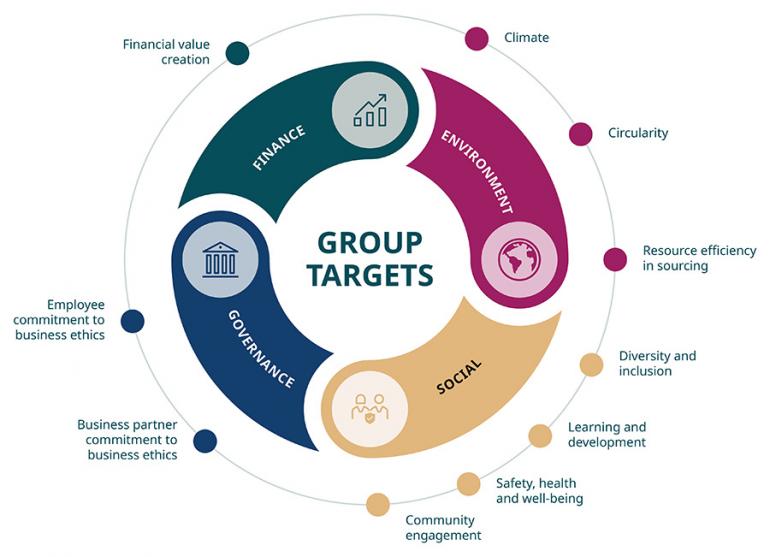
In line with the European Union’s Ecodesign Regulation, Atlas Copco Group has set a goal to apply circularity principles to all new and redesigned products by 2027. This entails developing goods and services that reduce dependence on raw materials, extend the operational life of machinery, and minimize waste generation. In this context, the Group also aims to reduce, recycle, or recover 100% of waste generated by its internal operational activities by 2030. To ensure a consistent and uniform application of circular economy principles, Atlas Copco Group has established a common working methodology across all Business Areas, supported by training programs for employees at all organizational levels.
Concrete developments in sustainable solutions
Compressor Technique, the Group’s Business Area providing equipment and services for the production and treatment of compressed air and industrial gases, as well as energy conversion and filtration, applies a circular design approach that focuses on reducing component weight, integrating optimal functionalities, and eliminating harmful substances such as PFAS (per- and polyfluoroalkyl substances), a group of synthetic materials resistant to degradation. Ease of maintenance has long been a strategic priority, with a continuous commitment to improving repairability and ease of disassembly in order to extend the operational life of machinery.
Power Technique, the division offering portable solutions for air compression, energy generation and management, lighting, and pumping technologies for drainage and industrial use, has developed a high-pressure single-shaft compressor featuring a more compact design and reduced weight compared to previous dual-shaft models. While maintaining the same flow rate and pressure, this solution reduces carbon emissions by approximately 20%.
Vacuum Technique, specialized in vacuum technologies, exhaust and cryogenic systems, as well as maintenance and diagnostic services, has designed a compact, oil-sealed rotary vane vacuum pump using 60% fewer components than previous generations.
Industrial Technique, active in automated assembly and quality control systems - including robotic tightening systems, automatic feeding, and machine vision - has developed a range of battery-powered screwdrivers with a modular design that allows easy access to all components. This facilitates disassembly, repair, and maintenance operations, while the reduction of permanent fastening systems also enables more efficient recycling.
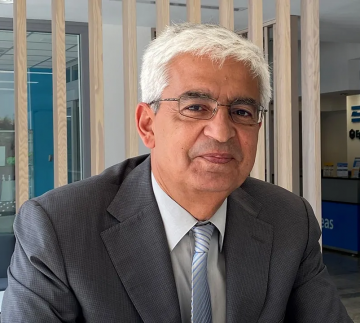
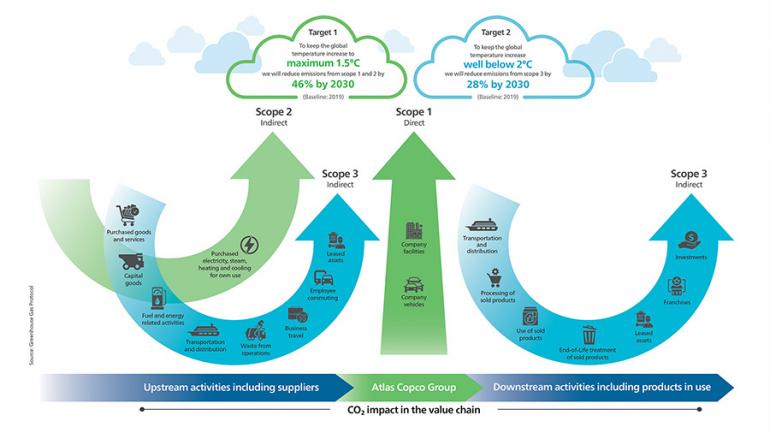
Circularity is an integral part of the Group’s sustainable development strategy, driving profitable and responsible growth through products and services that generate positive impact for businesses, society, and the environment - said Jose Manuel Funcia, Vice President Holding South Europe and Greater Maghreb - Atlas Copco has set science-based emissions reduction targets aligned with the SBTi initiative, aiming for a 46% reduction in Scope 1 and 2 emissions and a 28% reduction in Scope 3 emissions by 2030 compared to the 2019 baseline. Additionally, by 2026, the Group plans to develop a long-term climate transition plan (beyond 2030) covering all three scopes


